
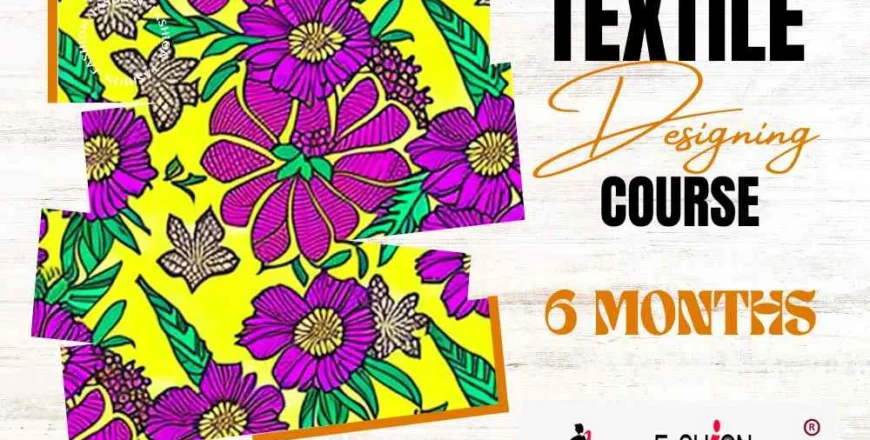
Textile Designing Course

- Description
- Reviews
- Grade
-
2
 What is Fabric?
 -
3
Fibre to Fabric
-
4
Types of Fibre
-
5
Characteristics of Fabric

Fibres are the basic components of textile fabrics. Each has a unique characteristic that it lends to the fabrics made from it. Although fabric’s character can be altered by yarn structure, by the type of weave and also by the finish that is given to the fabric, the original personality is still evident in the final fabric and is important to its uses and its care. Before this century all the fabrics were made from natural sources. In recent years a plethora of new fabrics has come into the markets, which are product of chemical laboratory or in other words are man-made. There is a variety of fabrics available in the market; these can be broadly divided into three major categories:
- Natural
- Man Made
- Blends of natural and man made
Natural fabrics are further categorized into those fabrics, which are procured from animals and those, which originate from plants. The commonly available and used Animal Fabrics are silk, wool, fur, leather etc. Some experts do not include fur and leather in textile fabrics technically, as they are skins of animals. On the other hand some include them, as they are widely used as an alternative to textile fabrics both for garments and household products. The most commonly available and used Plant Fabrics are cotton and linen.
Characteristics: Natural fibres have the irregularities and sensitivity inherent in natural things. These contribute to the beauty of natural fabrics.
Advantages: These fibres due to their natural character have common qualities of being absorbent and are breathable due to the porous structure. Thus, they are more responsive to climatic changes in temperature and humidity and are hence more comfortable to wear in a variety of climatic conditions.
The disadvantage of natural fabrics especially for cotton and linen, which is also an inherent quality, is that due to less elasticity they tend to wrinkle. This is also being overcome with a variety of wrinkle-resistant finishes, though at the cost of some comfort. Mercerised cotton is a common example of wrinkle-resistant finish without the application of chemicals, where cotton fibre is spun at very high tension to produce sheen in the yarn and make it more supple thus making it wrinkle-resistant.
Characteristics: All synthetic fabrics have their beginnings in chemical solutions that are forced through tiny holes into chemical bath or air chamber; these harden into long ropes of fibres that are later woven into fabrics. Advantages: All synthetic fibres are elastic hence they are wrinkle-resistant. Disadvantage: On the other hand almost all manmade fibres are less porous hence they are uncomfortable in hot and humid weather. Certain synthetics like Nylon are thermoplastic and hence can be moulded at controlled temperature and pressure to create interesting textures and design variations; they are called heat-set designs. An all time favourite of this design is heat set pleats. Japanese designers have explored a lot in this technique and have mastered the art of heat set pleating. This pleating can be done at any stage in fabric production at fibre stage, yarn stage or on the final fabric.
Blended Fabrics are combinations of two or more different fabrics. Usually the fibre present in higher percentage dominates the characteristics of the final fabric, but a successful blend will have desirable qualities of all fabrics. One such successful and popular fabric is Terry cot® which is a blend of 65% Cotton and 35% Terylene.
A common problem with the synthetics is the large number of terms used to identify them. For example, Acrylic may be called Orlon® & Acrilan® as they are the registered trademarks of some companies which generally confuse the consumers. In India, the consumer generally recognizes the fabrics by the trade names or the common group terms by which a shopkeeper might be referring to them. Second problem that we face in India is of the common consumer being misled by the shopkeepers selling polyester blended silk as Khadi silk and claiming it to be pure silk. Hence the consumer needs to learn to identify the commonly used fabrics as most of the fabrics cannot be identified only by their appearance. You can read the information on the fabric bolt, as it is compulsory for the manufacturer to print it on the fabric. In some of the developed countries, where consumer rights are a major consideration, the retailer also has to put a tag containing information on care and fibre content and a customer can ask for the same at the time of purchase.
-
6
 Quiz on Fabric
-
43
What is Tie and Dye
-
44
 Types of Dye Colors
 -
45
Turmeric Tie and Dye
-
46
Chemical Tie and Dye
-
47
Natural Tie and Dye
-
48
Tying Techniques
-
49
19 Tying techniques
-
50
Spiral Tie and Dye Technique
-
51
Crumple Tie and Dye Technique
Crumple Tie-Dye Technique
No twisting, folding or pleating needed for this super easy tie-dye technique; just straight up scrunching!


All you need to get started is an item to tie dye and your color of choice! Make sure the item you are going to tie dye is white or a very light colour, and made from 100% cotton or another natural-fiber fabric for best and brightest results. Before tie dyeing your item, make sure to wash it (without fabric softener) and leave damp. There's no need to presoak it in soda ash because Tulip One-Step Dyes already have soda ash in the formula. Cover your work area with a disposable plastic surface cover and you're ready to get started on the crumple tie-dye technique!

Lay your damp fabric out on the covered work surface. Scrunch the fabric into a crumpled mound. You can make the fabric loosely crumpled or really squish it all together for tighter, more defined crumples.

If you want to, you can secure your crumpled fabric with rubber bands before tie dyeing. This will help hold those crumples together more tightly if you are trying to achieve a super defined crumple tie-dye pattern. But you don't have to secure with rubber bands for this tiedye look; it will still turn out looking awesome!

Mix your Tulip One-Step Dyes according to the packaging instructions, then apply to your crumpled fabric. You can apply one dye colour or multiple dye colours - there's no wrong way to do it! Tip: If you are applying several dye colours, it's okay to allow the dyes to mix on the damp fabric, just make sure they're colours that blend nicely together (example: red + blue = purple). Some colours will turn a brownish colour if they mix, so if you're unsure, try blending them together on scrap fabric first. Don't forget to flip your scrunched fabric over and apply dye to the backside as well. Place it in a sealed bag or cover with plastic to keep damp while the dye sets, then launder according to instructions.
-
52
Accordion Tie-Dye Technique
-
53
Bullseye Tie Dye Technique
-
54
Chevron Tie-Dye Technique
-
55
Diamond Tie-Dye Technique
-
56
Folding Tie-Dye Technique
-
57
Galaxy Tie-Dye Technique
-
58
Heart Tie-Dye Technique
-
59
Kaleidoscope Ice Tie-Dye Technique
-
60
Mandala Tie-Dye Technique
-
61
Ombre Tie-Dye Technique
-
62
Reverse Tie-Dye Technique
-
63
Shibori Tie-Dye Technique
-
64
Spider Tie-Dye Technique
-
65
String Tie-Dye Technique
-
66
Stripes Tie-Dye Technique
-
67
Sunburst Tie-Dye Technique
-
68
Watercolour Tie-Dye Technique
-
69
 Tie and Dye Assignment